The global food and beverage industry is undergoing a fundamental transformation as consumers increasingly prioritize health, transparency, and natural ingredients in their daily diets. Against this backdrop, the Monk Fruit Sweetener Market is emerging as a key segment within the natural sweeteners landscape. Monk fruit sweeteners, derived from the fruit Siraitia grosvenorii, offer intense sweetness without calories, making them an attractive alternative to sugar and artificial sweeteners.
Download Sample Pages of Research Overview: https://www.maximizemarketresearch.com/request-sample/262033/
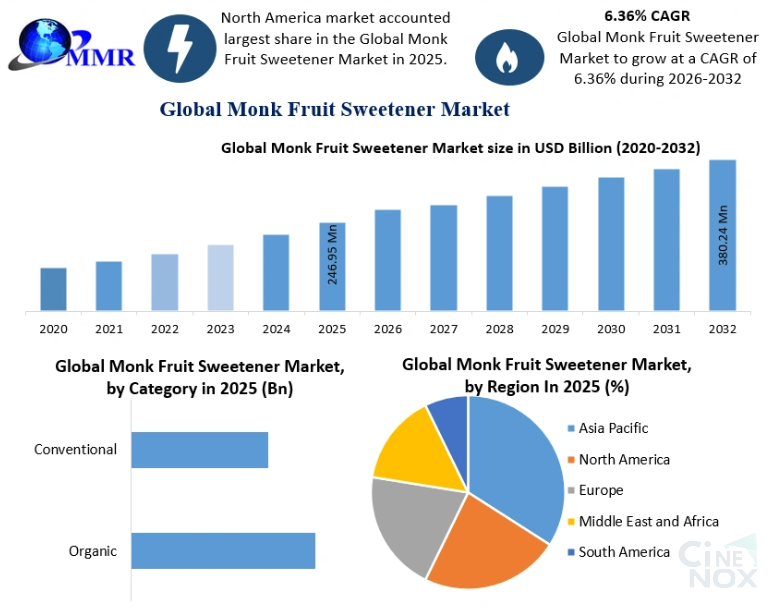
In 2025, the global Monk Fruit Sweetener Market was valued at USD 246.95 Million. Supported by strong demand from food and beverage manufacturers, growing awareness of the health risks associated with excessive sugar intake, and favorable regulatory developments, the market is projected to grow at a CAGR of 6.36% from 2025 to 2032, reaching nearly USD 380.24 Million by 2032. This steady growth reflects the increasing acceptance of monk fruit sweeteners across both developed and emerging economies.
Market Overview
Monk fruit sweeteners are zero-calorie, plant-based sweeteners extracted from monk fruit using processes that isolate mogrosides, the compounds responsible for the fruit’s natural sweetness. Unlike artificial sweeteners, monk fruit sweeteners are perceived as clean-label ingredients, aligning with consumer demand for transparency and simplicity in food formulations.
Key Growth Drivers
Growing Awareness of Health Benefits
Rising Demand for Natural Ingredients
Expanding Applications Across Industries
Innovation in blending monk fruit with other natural sweeteners such as erythritol and allulose is also broadening its application range, enabling manufacturers to optimize taste, texture, and cost.
Download Sample Pages of Research Overview: https://www.maximizemarketresearch.com/request-sample/262033/
Market Segmentation
The Monk Fruit Sweetener Market is segmented by form, category, application, and region.
By form, the market includes powdered and liquid monk fruit sweeteners. Powdered forms held the largest market share in 2025 due to their versatility, longer shelf life, and widespread use in baking and processed foods. Liquid forms are gaining popularity in beverages and tabletop sweeteners.
By category, the market is divided into organic and conventional monk fruit sweeteners. Organic variants are witnessing faster growth, driven by premiumization trends and increasing consumer willingness to pay for certified organic products.
By application, key segments include food and beverages, bakery and confectionery, pharmaceuticals, and others, with food and beverages accounting for the dominant share.
Download Sample Pages of Research Overview: https://www.maximizemarketresearch.com/request-sample/262033/
Regional Analysis
North America led the global monk fruit sweetener market in 2025, supported by a mature food and beverage industry, strong consumer awareness, and rapid adoption of sugar-reduction strategies. Major multinational brands, including Coca-Cola and PepsiCo, have incorporated monk fruit sweeteners into select product lines to cater to health-focused consumers.
Europe is witnessing steady growth, aided by regulatory support for natural sweeteners and increasing demand for clean-label products. Recent regulatory clarity in the UK has further improved market prospects.
Asia Pacific represents a high-growth region due to rising disposable incomes, urbanization, and a growing middle-class population seeking healthier dietary options. Countries such as China, India, and Japan are playing a crucial role in both production and consumption.
Major Players
The competitive landscape is moderately consolidated, with key players focusing on innovation, strategic partnerships, and capacity expansion. Prominent companies operating in the global monk fruit sweetener market include Monk Fruit Corp., Cargill, Tate & Lyle, Archer Daniels Midland Company, and GLG Life Tech Corp.. These companies are investing in R&D to improve extraction efficiency and reduce costs while expanding their global footprint.
Connect With Us:
MAXIMIZE MARKET RESEARCH PVT. LTD.
2nd Floor, Navale IT park Phase 3,
Pune Banglore Highway, Narhe
Pune, Maharashtra 411041, India.
+91 9607365656
sales@maximizemarketresearch.com
About Maximize Market Research:
Maximize Market Research is one of the fastest-growing market research and business consulting firms serving clients globally. Our revenue impact and focused growth-driven research initiatives make us a proud partner of majority of the Fortune 500 companies. We have a diversified portfolio and serve a variety of industries such as IT & telecom, chemical, food & beverage, aerospace & defense, healthcare and others.
Download Sample Pages of Research Overview: https://www.maximizemarketresearch.com/request-sample/262033/
In 2025, the global Monk Fruit Sweetener Market was valued at USD 246.95 Million. Supported by strong demand from food and beverage manufacturers, growing awareness of the health risks associated with excessive sugar intake, and favorable regulatory developments, the market is projected to grow at a CAGR of 6.36% from 2025 to 2032, reaching nearly USD 380.24 Million by 2032. This steady growth reflects the increasing acceptance of monk fruit sweeteners across both developed and emerging economies.
Market Overview
Monk fruit sweeteners are zero-calorie, plant-based sweeteners extracted from monk fruit using processes that isolate mogrosides, the compounds responsible for the fruit’s natural sweetness. Unlike artificial sweeteners, monk fruit sweeteners are perceived as clean-label ingredients, aligning with consumer demand for transparency and simplicity in food formulations.
Key Growth Drivers
Growing Awareness of Health Benefits
Rising Demand for Natural Ingredients
Expanding Applications Across Industries
Innovation in blending monk fruit with other natural sweeteners such as erythritol and allulose is also broadening its application range, enabling manufacturers to optimize taste, texture, and cost.
Download Sample Pages of Research Overview: https://www.maximizemarketresearch.com/request-sample/262033/
Market Segmentation
The Monk Fruit Sweetener Market is segmented by form, category, application, and region.
By form, the market includes powdered and liquid monk fruit sweeteners. Powdered forms held the largest market share in 2025 due to their versatility, longer shelf life, and widespread use in baking and processed foods. Liquid forms are gaining popularity in beverages and tabletop sweeteners.
By category, the market is divided into organic and conventional monk fruit sweeteners. Organic variants are witnessing faster growth, driven by premiumization trends and increasing consumer willingness to pay for certified organic products.
By application, key segments include food and beverages, bakery and confectionery, pharmaceuticals, and others, with food and beverages accounting for the dominant share.
Download Sample Pages of Research Overview: https://www.maximizemarketresearch.com/request-sample/262033/
Regional Analysis
North America led the global monk fruit sweetener market in 2025, supported by a mature food and beverage industry, strong consumer awareness, and rapid adoption of sugar-reduction strategies. Major multinational brands, including Coca-Cola and PepsiCo, have incorporated monk fruit sweeteners into select product lines to cater to health-focused consumers.
Europe is witnessing steady growth, aided by regulatory support for natural sweeteners and increasing demand for clean-label products. Recent regulatory clarity in the UK has further improved market prospects.
Asia Pacific represents a high-growth region due to rising disposable incomes, urbanization, and a growing middle-class population seeking healthier dietary options. Countries such as China, India, and Japan are playing a crucial role in both production and consumption.
Major Players
The competitive landscape is moderately consolidated, with key players focusing on innovation, strategic partnerships, and capacity expansion. Prominent companies operating in the global monk fruit sweetener market include Monk Fruit Corp., Cargill, Tate & Lyle, Archer Daniels Midland Company, and GLG Life Tech Corp.. These companies are investing in R&D to improve extraction efficiency and reduce costs while expanding their global footprint.
Connect With Us:
MAXIMIZE MARKET RESEARCH PVT. LTD.
2nd Floor, Navale IT park Phase 3,
Pune Banglore Highway, Narhe
Pune, Maharashtra 411041, India.
+91 9607365656
sales@maximizemarketresearch.com
About Maximize Market Research:
Maximize Market Research is one of the fastest-growing market research and business consulting firms serving clients globally. Our revenue impact and focused growth-driven research initiatives make us a proud partner of majority of the Fortune 500 companies. We have a diversified portfolio and serve a variety of industries such as IT & telecom, chemical, food & beverage, aerospace & defense, healthcare and others.
The global food and beverage industry is undergoing a fundamental transformation as consumers increasingly prioritize health, transparency, and natural ingredients in their daily diets. Against this backdrop, the Monk Fruit Sweetener Market is emerging as a key segment within the natural sweeteners landscape. Monk fruit sweeteners, derived from the fruit Siraitia grosvenorii, offer intense sweetness without calories, making them an attractive alternative to sugar and artificial sweeteners.
Download Sample Pages of Research Overview: https://www.maximizemarketresearch.com/request-sample/262033/
In 2025, the global Monk Fruit Sweetener Market was valued at USD 246.95 Million. Supported by strong demand from food and beverage manufacturers, growing awareness of the health risks associated with excessive sugar intake, and favorable regulatory developments, the market is projected to grow at a CAGR of 6.36% from 2025 to 2032, reaching nearly USD 380.24 Million by 2032. This steady growth reflects the increasing acceptance of monk fruit sweeteners across both developed and emerging economies.
Market Overview
Monk fruit sweeteners are zero-calorie, plant-based sweeteners extracted from monk fruit using processes that isolate mogrosides, the compounds responsible for the fruit’s natural sweetness. Unlike artificial sweeteners, monk fruit sweeteners are perceived as clean-label ingredients, aligning with consumer demand for transparency and simplicity in food formulations.
Key Growth Drivers
Growing Awareness of Health Benefits
Rising Demand for Natural Ingredients
Expanding Applications Across Industries
Innovation in blending monk fruit with other natural sweeteners such as erythritol and allulose is also broadening its application range, enabling manufacturers to optimize taste, texture, and cost.
Download Sample Pages of Research Overview: https://www.maximizemarketresearch.com/request-sample/262033/
Market Segmentation
The Monk Fruit Sweetener Market is segmented by form, category, application, and region.
By form, the market includes powdered and liquid monk fruit sweeteners. Powdered forms held the largest market share in 2025 due to their versatility, longer shelf life, and widespread use in baking and processed foods. Liquid forms are gaining popularity in beverages and tabletop sweeteners.
By category, the market is divided into organic and conventional monk fruit sweeteners. Organic variants are witnessing faster growth, driven by premiumization trends and increasing consumer willingness to pay for certified organic products.
By application, key segments include food and beverages, bakery and confectionery, pharmaceuticals, and others, with food and beverages accounting for the dominant share.
Download Sample Pages of Research Overview: https://www.maximizemarketresearch.com/request-sample/262033/
Regional Analysis
North America led the global monk fruit sweetener market in 2025, supported by a mature food and beverage industry, strong consumer awareness, and rapid adoption of sugar-reduction strategies. Major multinational brands, including Coca-Cola and PepsiCo, have incorporated monk fruit sweeteners into select product lines to cater to health-focused consumers.
Europe is witnessing steady growth, aided by regulatory support for natural sweeteners and increasing demand for clean-label products. Recent regulatory clarity in the UK has further improved market prospects.
Asia Pacific represents a high-growth region due to rising disposable incomes, urbanization, and a growing middle-class population seeking healthier dietary options. Countries such as China, India, and Japan are playing a crucial role in both production and consumption.
Major Players
The competitive landscape is moderately consolidated, with key players focusing on innovation, strategic partnerships, and capacity expansion. Prominent companies operating in the global monk fruit sweetener market include Monk Fruit Corp., Cargill, Tate & Lyle, Archer Daniels Midland Company, and GLG Life Tech Corp.. These companies are investing in R&D to improve extraction efficiency and reduce costs while expanding their global footprint.
Connect With Us:
MAXIMIZE MARKET RESEARCH PVT. LTD.
2nd Floor, Navale IT park Phase 3,
Pune Banglore Highway, Narhe
Pune, Maharashtra 411041, India.
+91 9607365656
sales@maximizemarketresearch.com
About Maximize Market Research:
Maximize Market Research is one of the fastest-growing market research and business consulting firms serving clients globally. Our revenue impact and focused growth-driven research initiatives make us a proud partner of majority of the Fortune 500 companies. We have a diversified portfolio and serve a variety of industries such as IT & telecom, chemical, food & beverage, aerospace & defense, healthcare and others.
0 Comments
0 Shares
36 Views
0 Reviews