Sponsored
Curved Autoplay YouTube Video
  • Global PWM Controllers Market Set to Reach USD 13.1 Billion by 2032, Driven by Electrification and Digitalization Trends

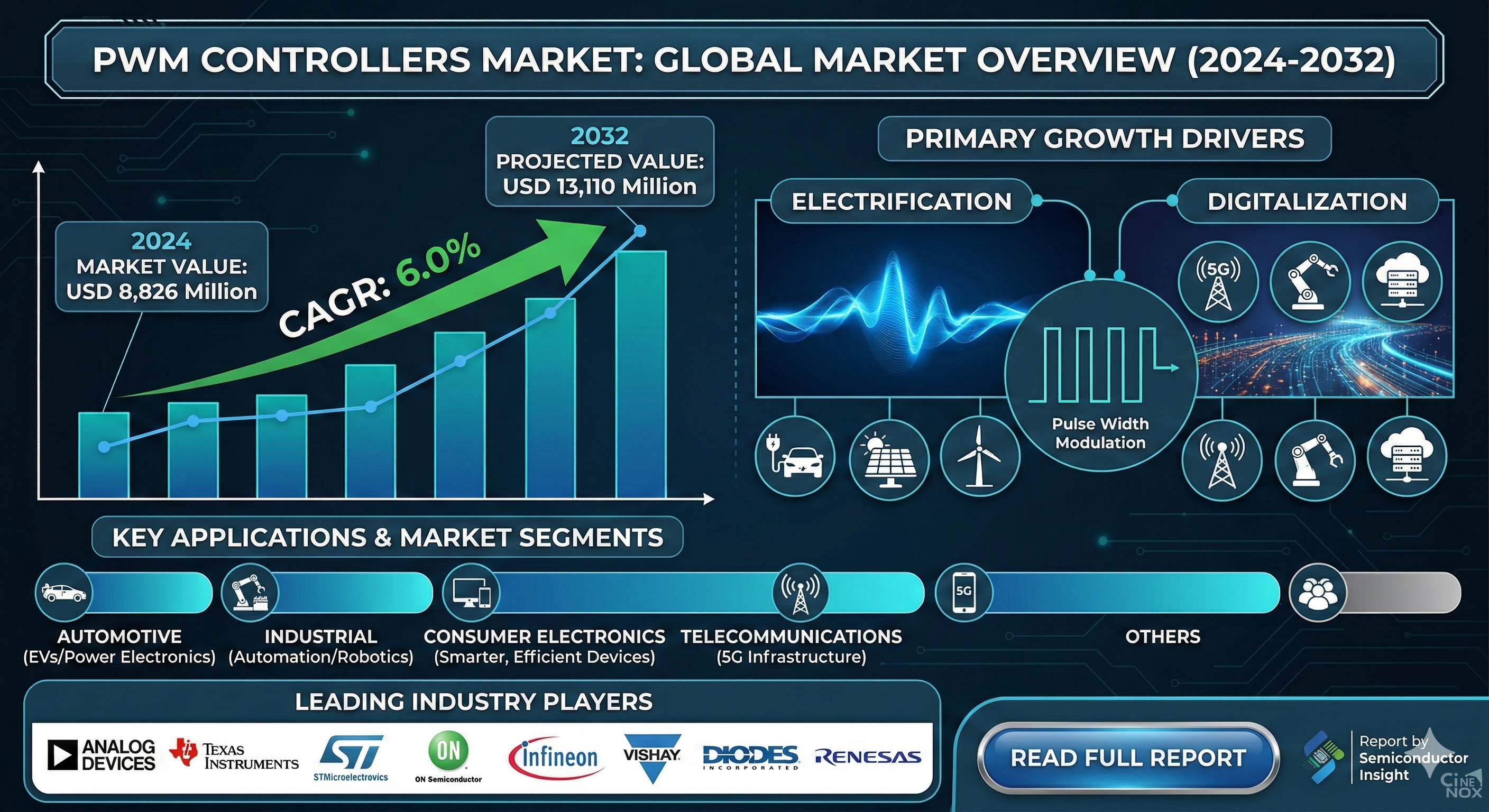
    The global Pulse Width Modulation (PWM) Controllers Market is positioned for steady growth, projected to rise from USD 8.8 billion in 2024 to USD 13.1 billion by 2032, reflecting a CAGR of 6.0%. According to a report by Semiconductor Insight, this expansion is primarily fueled by the twin forces of global electrification and digitalization.
    PWM controllers are essential silicon components that regulate power delivery with high efficiency by rapidly switching current on and off. Their ability to minimize heat loss while providing precise voltage control makes them indispensable in the modern transition toward energy-conscious technology.
    Key Market Highlights:
    Primary Drivers: The shift toward Electric Vehicles (EVs), the rollout of 5G telecommunications, and the rise of intelligent industrial automation.
    Leading Segments: Current Mode Controllers and Industrial Applications currently dominate the market landscape.
    Technology Trends: There is a growing shift toward integrating PWM functionality into System-on-Chip (SoC) designs and developing controllers with higher switching frequencies to allow for smaller overall device footprints.
    Competitive Landscape: Industry leaders include Texas Instruments, Analog Devices, STMicroelectronics, Infineon, and ON Semiconductor, all of whom are focusing on geographic expansion into the high-growth Asia-Pacific region.
    Get Full Report Here: Pulse Width Modulation (PWM) Controllers Market, Global Business Strategies 2025-2032 - View in Detailed Research Report
    Download Sample Report: https://semiconductorinsight.com/download-sample-report/?product_id=122483
    #Semiconductors #PWMControllers #PowerManagement #TechTrends2026 #ElectricVehicles #DigitalTransformation #EnergyEfficiency #IndustrialAutomation #ElectronicsIndustry #MarketResearch #SemiconductorInsight
    Global PWM Controllers Market Set to Reach USD 13.1 Billion by 2032, Driven by Electrification and Digitalization Trends The global Pulse Width Modulation (PWM) Controllers Market is positioned for steady growth, projected to rise from USD 8.8 billion in 2024 to USD 13.1 billion by 2032, reflecting a CAGR of 6.0%. According to a report by Semiconductor Insight, this expansion is primarily fueled by the twin forces of global electrification and digitalization. PWM controllers are essential silicon components that regulate power delivery with high efficiency by rapidly switching current on and off. Their ability to minimize heat loss while providing precise voltage control makes them indispensable in the modern transition toward energy-conscious technology. Key Market Highlights: Primary Drivers: The shift toward Electric Vehicles (EVs), the rollout of 5G telecommunications, and the rise of intelligent industrial automation. Leading Segments: Current Mode Controllers and Industrial Applications currently dominate the market landscape. Technology Trends: There is a growing shift toward integrating PWM functionality into System-on-Chip (SoC) designs and developing controllers with higher switching frequencies to allow for smaller overall device footprints. Competitive Landscape: Industry leaders include Texas Instruments, Analog Devices, STMicroelectronics, Infineon, and ON Semiconductor, all of whom are focusing on geographic expansion into the high-growth Asia-Pacific region. Get Full Report Here: Pulse Width Modulation (PWM) Controllers Market, Global Business Strategies 2025-2032 - View in Detailed Research Report Download Sample Report: https://semiconductorinsight.com/download-sample-report/?product_id=122483 #Semiconductors #PWMControllers #PowerManagement #TechTrends2026 #ElectricVehicles #DigitalTransformation #EnergyEfficiency #IndustrialAutomation #ElectronicsIndustry #MarketResearch #SemiconductorInsight
    0 Comments 0 Shares 34 Views 0 Reviews

  • EUV Pellicle Market Surges as Semiconductor Industry Embraces Next-Generation Lithography

    The global market for EUV pellicles is experiencing robust growth, driven by the relentless push for smaller, more powerful semiconductors. According to a comprehensive new report by 24chemicalresearch, the market is projected to reach USD 163 million by 2032, expanding at a compound annual growth rate (CAGR) of 9.3% from its 2024 valuation of USD 72 million.

    Download Your FREE Sample Report Here:
    https://www.24chemicalresearch.com/download-sample/294188/euv-pellicle-market

    EUV Pellicle Market Surges as Semiconductor Industry Embraces Next-Generation Lithography The global market for EUV pellicles is experiencing robust growth, driven by the relentless push for smaller, more powerful semiconductors. According to a comprehensive new report by 24chemicalresearch, the market is projected to reach USD 163 million by 2032, expanding at a compound annual growth rate (CAGR) of 9.3% from its 2024 valuation of USD 72 million. Download Your FREE Sample Report Here: https://www.24chemicalresearch.com/download-sample/294188/euv-pellicle-market
    Sample Report: EUV Pellicle Market, Global Outlook and Forecast 2025-2032
    Download Sample Report PDF : Global EUV Pellicle market was valued at USD 72 million in 2024 and is projected to reach USD 163 million by 2032, at a CAGR of 9.3% during the forecast period.
    0 Comments 0 Shares 36 Views 0 Reviews
  • Global Ethernet Switch Chips Market Analysis (2025–2032)
    The global Ethernet switch chips market is undergoing a significant transformation, with its valuation expected to rise from USD 3,495 million in 2025 to USD 4,868 million by 2032. This growth, representing a CAGR of 5.6%, is primarily fueled by the infrastructure demands of Artificial Intelligence (AI) and the expansion of hyperscale data centers.

    Market Overview and Core Functionality
    Ethernet switch chips serve as the "silicon brains" of networking hardware. These integrated circuits (ICs) are responsible for the efficient direction of data packets across Local Area Networks (LANs). As digital ecosystems evolve, these chips have become the bedrock of high-speed, low-latency communication required for:

    Enterprise Networking: Streamlining internal corporate data flow.

    Cloud Computing: Supporting the massive virtualization of services.

    AI Training & Inference: Managing the heavy parallel processing loads of modern machine learning.

    The AI and Hyperscale Catalyst
    The "explosive growth" of AI workloads is identified as the paramount driver for the industry. AI environments require unprecedented bandwidth to prevent bottlenecks in data pipelines.

    High-Speed Transition: The industry is rapidly shifting toward 400GbE and 800GbE switch chips.

    Performance Demands: Hyperscale data centers necessitate ultra-low latency to maintain the efficiency of high-performance computing (HPC) clusters.

    Efficiency: There is an intensified focus on power-efficient switching solutions to manage the massive energy consumption of modern data hubs.

    Market Segmentation
    The market is categorized by function, application, and performance capabilities to provide a granular view of growth areas:

    By Type: Core Switches, Distribution Switches, and Access Switches.

    By Application: Data Centers (Dominant), Enterprise Networking, Telecommunications, Industrial Automation, and others.

    By Bandwidth: * < 1 Gbps

    1 Gbps to 10 Gbps

    10 Gbps to 40 Gbps

    100 Gbps and Above (Fastest growing segment)

    Competitive Landscape: Industry Titans
    Key players are currently engaged in a "silicon arms race" to develop chips capable of supporting 1.6TbE speeds and advanced network virtualization. Leading companies include:

    Market Leaders: Broadcom Inc., Cisco Systems, Marvell Technology, Intel, and NVIDIA (Mellanox).

    Specialized & Regional Players: Centec Communications (China), MaxLinear, Rohm Semiconductor, Microchip Technology, Renesas Electronics, NXP Semiconductors, and Realtek.

    Emerging Trends and Future Opportunities
    Beyond the traditional data center, several technological shifts are creating new revenue streams:

    Network Transformation: The move toward Software-Defined Networking (SDN) and Network Function Virtualization (NFV) requires highly programmable silicon.

    Edge Computing: Increasing demand for ruggedized, low-power chips for localized processing in smart cities, retail, and manufacturing.

    Silicon-Level Security: Integrating security features directly into the chip to defend against sophisticated cyber threats at the hardware level.

    Conclusion
    As AI infrastructure investments continue to scale globally, the Ethernet switch chip market remains a critical pillar of the semiconductor industry. The transition to higher speeds and more flexible architectures will define the competitive landscape through 2032.
    Global Ethernet Switch Chips Market Analysis (2025–2032) The global Ethernet switch chips market is undergoing a significant transformation, with its valuation expected to rise from USD 3,495 million in 2025 to USD 4,868 million by 2032. This growth, representing a CAGR of 5.6%, is primarily fueled by the infrastructure demands of Artificial Intelligence (AI) and the expansion of hyperscale data centers. Market Overview and Core Functionality Ethernet switch chips serve as the "silicon brains" of networking hardware. These integrated circuits (ICs) are responsible for the efficient direction of data packets across Local Area Networks (LANs). As digital ecosystems evolve, these chips have become the bedrock of high-speed, low-latency communication required for: Enterprise Networking: Streamlining internal corporate data flow. Cloud Computing: Supporting the massive virtualization of services. AI Training & Inference: Managing the heavy parallel processing loads of modern machine learning. The AI and Hyperscale Catalyst The "explosive growth" of AI workloads is identified as the paramount driver for the industry. AI environments require unprecedented bandwidth to prevent bottlenecks in data pipelines. High-Speed Transition: The industry is rapidly shifting toward 400GbE and 800GbE switch chips. Performance Demands: Hyperscale data centers necessitate ultra-low latency to maintain the efficiency of high-performance computing (HPC) clusters. Efficiency: There is an intensified focus on power-efficient switching solutions to manage the massive energy consumption of modern data hubs. Market Segmentation The market is categorized by function, application, and performance capabilities to provide a granular view of growth areas: By Type: Core Switches, Distribution Switches, and Access Switches. By Application: Data Centers (Dominant), Enterprise Networking, Telecommunications, Industrial Automation, and others. By Bandwidth: * < 1 Gbps 1 Gbps to 10 Gbps 10 Gbps to 40 Gbps 100 Gbps and Above (Fastest growing segment) Competitive Landscape: Industry Titans Key players are currently engaged in a "silicon arms race" to develop chips capable of supporting 1.6TbE speeds and advanced network virtualization. Leading companies include: Market Leaders: Broadcom Inc., Cisco Systems, Marvell Technology, Intel, and NVIDIA (Mellanox). Specialized & Regional Players: Centec Communications (China), MaxLinear, Rohm Semiconductor, Microchip Technology, Renesas Electronics, NXP Semiconductors, and Realtek. Emerging Trends and Future Opportunities Beyond the traditional data center, several technological shifts are creating new revenue streams: Network Transformation: The move toward Software-Defined Networking (SDN) and Network Function Virtualization (NFV) requires highly programmable silicon. Edge Computing: Increasing demand for ruggedized, low-power chips for localized processing in smart cities, retail, and manufacturing. Silicon-Level Security: Integrating security features directly into the chip to defend against sophisticated cyber threats at the hardware level. Conclusion As AI infrastructure investments continue to scale globally, the Ethernet switch chip market remains a critical pillar of the semiconductor industry. The transition to higher speeds and more flexible architectures will define the competitive landscape through 2032.
    0 Comments 0 Shares 28 Views 0 Reviews
  • Why High Purity Helium Is Racing Past USD 4.2 Billion by 2031 – No Substitute for 3nm Chips & MRI

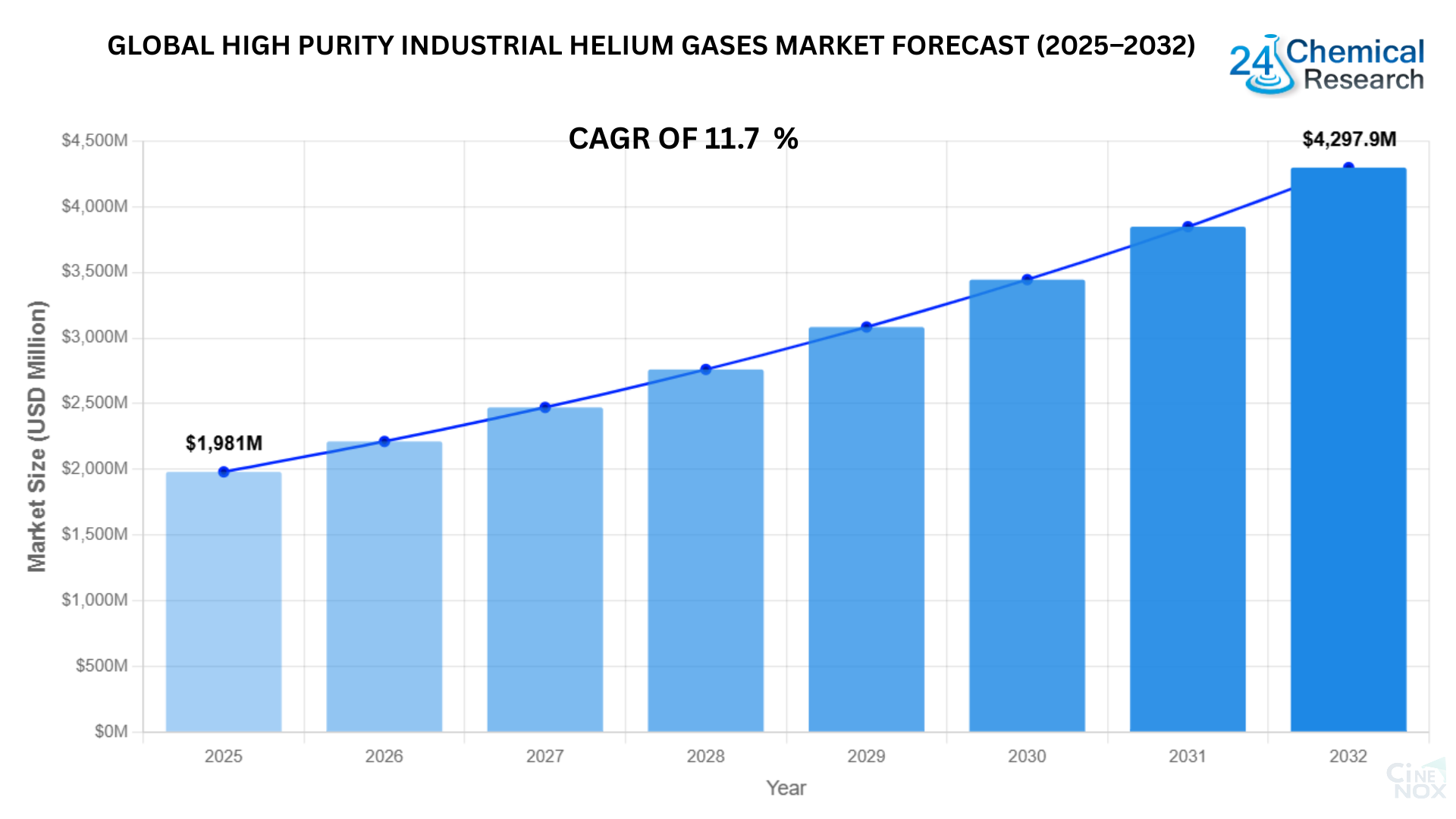
    Global High Purity Industrial Helium Gases market reached USD 1,981 million in 2024 and is projected to hit USD 4,221 million by 2031 (CAGR 11.7%). Growth is driven by surging demand in semiconductors, MRI systems, and aerospace, despite supply constraints. North America leads, Asia-Pacific grows fastest; key players include Qatargas, Linde, and Air Liquide

    Get Full Report Here: https://www.24chemicalresearch.com/reports/290723/global-high-purity-industrial-helium-gases-forecast-market-2025-2031-847
    Why High Purity Helium Is Racing Past USD 4.2 Billion by 2031 – No Substitute for 3nm Chips & MRI Global High Purity Industrial Helium Gases market reached USD 1,981 million in 2024 and is projected to hit USD 4,221 million by 2031 (CAGR 11.7%). Growth is driven by surging demand in semiconductors, MRI systems, and aerospace, despite supply constraints. North America leads, Asia-Pacific grows fastest; key players include Qatargas, Linde, and Air Liquide Get Full Report Here: https://www.24chemicalresearch.com/reports/290723/global-high-purity-industrial-helium-gases-forecast-market-2025-2031-847
    0 Comments 0 Shares 69 Views 0 Reviews
  • Why Lead Frame Copper Alloys Are Critical for Next-Gen Semiconductors – USD 2.86 Billion Market by 2032

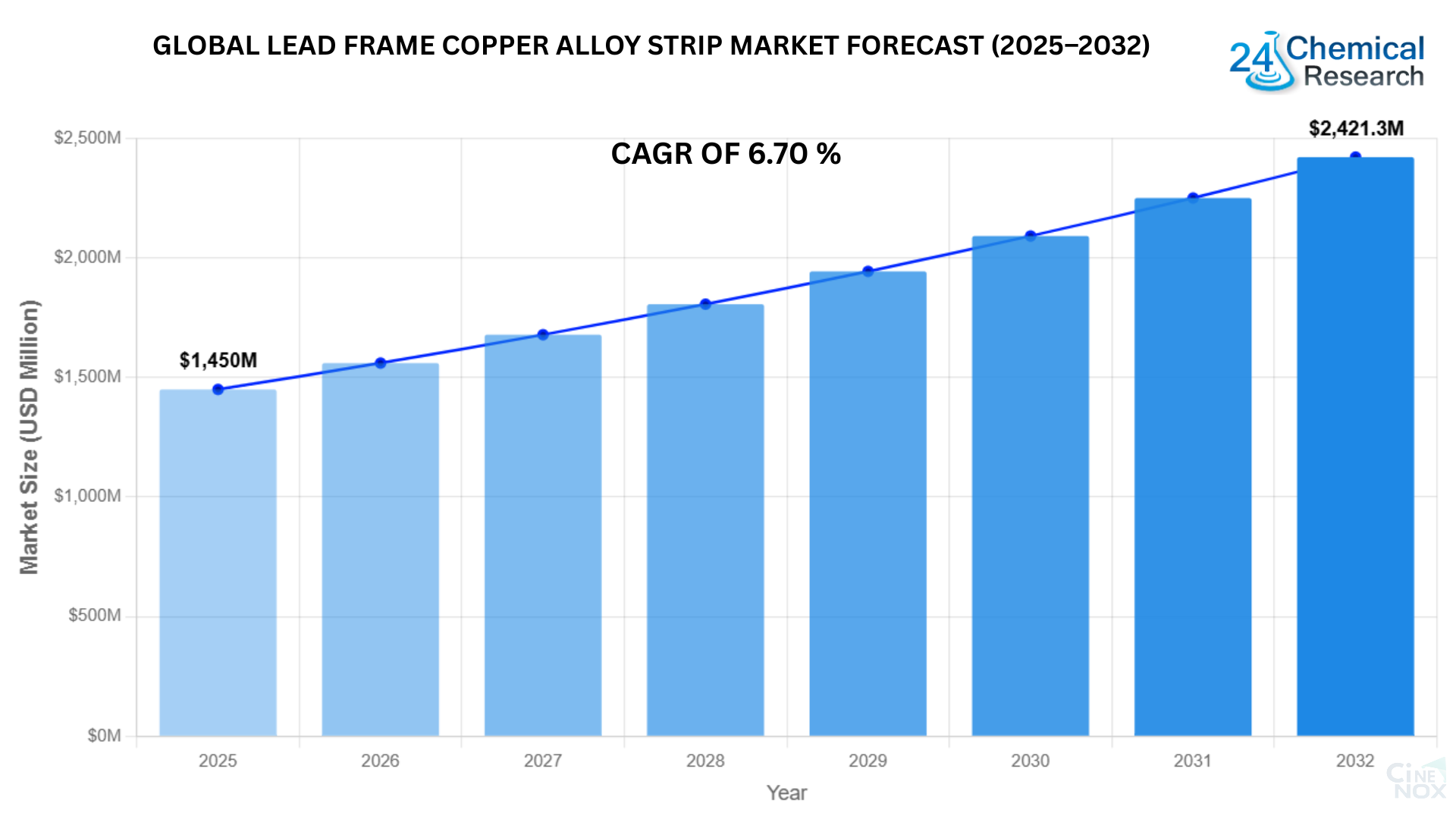
    Global Lead Frame Copper Alloy Strip Market was valued at USD 1.45 billion in 2024, projected to reach USD 2.86 billion by 2032 (CAGR 7.6%). Growth is fueled by the booming semiconductor and automotive electronics industries. Advanced alloys like Copper-Nickel-Silicon are accelerating miniaturization, but the market faces challenges from raw material volatility and competition from alternative packaging

    Get Full Report Here: https://www.24chemicalresearch.com/reports/239003/global-lead-frame-copper-alloy-strip-forecast-market-2023-2032-175
    Why Lead Frame Copper Alloys Are Critical for Next-Gen Semiconductors – USD 2.86 Billion Market by 2032 Global Lead Frame Copper Alloy Strip Market was valued at USD 1.45 billion in 2024, projected to reach USD 2.86 billion by 2032 (CAGR 7.6%). Growth is fueled by the booming semiconductor and automotive electronics industries. Advanced alloys like Copper-Nickel-Silicon are accelerating miniaturization, but the market faces challenges from raw material volatility and competition from alternative packaging Get Full Report Here: https://www.24chemicalresearch.com/reports/239003/global-lead-frame-copper-alloy-strip-forecast-market-2023-2032-175
    0 Comments 0 Shares 21 Views 0 Reviews
  • Global Minor Metals Market to Reach USD 41.2 Billion by 2030 Fueled by EV, Solar & Semiconductor Boom

    Valued at USD 29.7 Billion in 2024, the global minor metals market is projected to hit USD 41.2 Billion by 2030 at a 5.6% CAGR. Surging demand for gallium, indium, cobalt, rare earths and refractory metals in electric vehicles, renewable energy, semiconductors and aerospace drives robust growth amid tightening supply chains.

    Get Full Report Here: https://www.24chemicalresearch.com/reports/261117/global-minor-metals-forecast-market-2024-2030-663
    Global Minor Metals Market to Reach USD 41.2 Billion by 2030 Fueled by EV, Solar & Semiconductor Boom Valued at USD 29.7 Billion in 2024, the global minor metals market is projected to hit USD 41.2 Billion by 2030 at a 5.6% CAGR. Surging demand for gallium, indium, cobalt, rare earths and refractory metals in electric vehicles, renewable energy, semiconductors and aerospace drives robust growth amid tightening supply chains. Get Full Report Here: https://www.24chemicalresearch.com/reports/261117/global-minor-metals-forecast-market-2024-2030-663
    0 Comments 0 Shares 87 Views 0 Reviews
  • High Purity Tellurium Market: Solar Cell Demand Powers Growth Toward USD 390 Million by 2032

    High purity tellurium (HPT) market is growing steadily (4.3% CAGR to USD 390M by 2032), driven by solar cells (CdTe) and semiconductors. North America leads, but Asia-Pacific shows the strongest growth. Key challenges include raw material scarcity and purification complexity.

    Read our full Report: https://www.24chemicalresearch.com/reports/288729/global-high-purity-tellurium-forecast-market-2025-2032-440
    High Purity Tellurium Market: Solar Cell Demand Powers Growth Toward USD 390 Million by 2032 High purity tellurium (HPT) market is growing steadily (4.3% CAGR to USD 390M by 2032), driven by solar cells (CdTe) and semiconductors. North America leads, but Asia-Pacific shows the strongest growth. Key challenges include raw material scarcity and purification complexity. Read our full Report: https://www.24chemicalresearch.com/reports/288729/global-high-purity-tellurium-forecast-market-2025-2032-440
    0 Comments 0 Shares 33 Views 0 Reviews
  • Wireless Connectivity Technology Market Overview

    The global wireless connectivity technology market size was valued at USD 94.024 billion in 2024 and is projected to reach from USD 101 billion in 2025 to USD 180.26 billion by 2033, growing at a CAGR of 13.3% during the forecast period (2025-2033).

    Download Exclusive Research Report PDF Sample: (Including Full TOC, List of Tables & Figures, Chart) : https://straitsresearch.com/report/wireless-connectivity-technology-market/request-sample

    Wireless Connectivity Technology Market Report Scope and Research Methodology

    This report provides both qualitative and quantitative insights, ensuring reliability, transparency, and depth of analysis. The scope defines the boundaries and categories of the market, enabling a clear understanding of its structure and dynamics.

    The study evaluates market size and forecasts by analyzing key segments and sub-segments. It also explores drivers, restraints, and opportunities—including cost optimization, government initiatives, sustainability concerns, and ongoing technological innovations. Furthermore, the report examines competitive positioning, investment patterns, and regulatory influences shaping industry development.

    Wireless Connectivity Technology Market Regional Insights

    The regional assessment covers North America, Europe, Asia-Pacific, Latin America, the Middle East, and Africa. Each region is analyzed in terms of market share, growth trends, trade flows, and investment potential. By examining factors such as demand patterns, industry performance, and policy support, the report offers a comprehensive outlook on how the market evolves across diverse geographies.

    Download Exclusive Research Report PDF Sample: (Including Full TOC, List of Tables & Figures, Chart) : https://straitsresearch.com/report/wireless-connectivity-technology-market/request-sample

    Wireless Connectivity Technology Market Segmentation

    By Technology
    Wi-Fi
    Bluetooth
    Zigbee
    NFC
    Cellular
    Others
    By Application
    Consumer Electronics
    Automotive
    Healthcare
    Aerospace and Defense
    IT & Telecom
    Others
    Wireless Connectivity Technology Market Key Players

    Qualcomm Incorporated
    Intel Corporation
    NXP Semiconductors NV.
    Texas Instruments Inc.
    STMicroelectronics NV.
    Broadcom
    Panasonic Corporation
    Infineon Technologies AG
    Renesas Electronics
    MediaTek Inc.
    Download Exclusive Research Report PDF Sample: (Including Full TOC, List of Tables & Figures, Chart) : https://straitsresearch.com/report/wireless-connectivity-technology-market/request-sample

    Key questions answered in the Wireless Connectivity Technology Market are:

    How big is the Wireless Connectivity Technology market?
    What is the expected size of Wireless Connectivity Technology market?
    How much is the global Wireless Connectivity Technology market worth?
    What is the Wireless Connectivity Technology market growth?
    Which segment accounted for the largest Wireless Connectivity Technology market share?
    What are the key Wireless Connectivity Technology market segments?
    What was the value of the Wireless Connectivity Technology market in North America in 2024?
    Which region held the largest share of the market?
    What are the factors driving the Wireless Connectivity Technology market?
    What are the leading key players in the Wireless Connectivity Technology market?
    Who are the key players in Wireless Connectivity Technology market?
    About Straits Research:

    Straits Research delivers in-depth market intelligence and actionable insights across multiple industries. Our reports are designed to guide decision-makers, investors, and businesses in identifying growth opportunities, navigating challenges, and developing effective strategies for sustainable success.
    Wireless Connectivity Technology Market Overview The global wireless connectivity technology market size was valued at USD 94.024 billion in 2024 and is projected to reach from USD 101 billion in 2025 to USD 180.26 billion by 2033, growing at a CAGR of 13.3% during the forecast period (2025-2033). Download Exclusive Research Report PDF Sample: (Including Full TOC, List of Tables & Figures, Chart) : https://straitsresearch.com/report/wireless-connectivity-technology-market/request-sample Wireless Connectivity Technology Market Report Scope and Research Methodology This report provides both qualitative and quantitative insights, ensuring reliability, transparency, and depth of analysis. The scope defines the boundaries and categories of the market, enabling a clear understanding of its structure and dynamics. The study evaluates market size and forecasts by analyzing key segments and sub-segments. It also explores drivers, restraints, and opportunities—including cost optimization, government initiatives, sustainability concerns, and ongoing technological innovations. Furthermore, the report examines competitive positioning, investment patterns, and regulatory influences shaping industry development. Wireless Connectivity Technology Market Regional Insights The regional assessment covers North America, Europe, Asia-Pacific, Latin America, the Middle East, and Africa. Each region is analyzed in terms of market share, growth trends, trade flows, and investment potential. By examining factors such as demand patterns, industry performance, and policy support, the report offers a comprehensive outlook on how the market evolves across diverse geographies. Download Exclusive Research Report PDF Sample: (Including Full TOC, List of Tables & Figures, Chart) : https://straitsresearch.com/report/wireless-connectivity-technology-market/request-sample Wireless Connectivity Technology Market Segmentation By Technology Wi-Fi Bluetooth Zigbee NFC Cellular Others By Application Consumer Electronics Automotive Healthcare Aerospace and Defense IT & Telecom Others Wireless Connectivity Technology Market Key Players Qualcomm Incorporated Intel Corporation NXP Semiconductors NV. Texas Instruments Inc. STMicroelectronics NV. Broadcom Panasonic Corporation Infineon Technologies AG Renesas Electronics MediaTek Inc. Download Exclusive Research Report PDF Sample: (Including Full TOC, List of Tables & Figures, Chart) : https://straitsresearch.com/report/wireless-connectivity-technology-market/request-sample Key questions answered in the Wireless Connectivity Technology Market are: How big is the Wireless Connectivity Technology market? What is the expected size of Wireless Connectivity Technology market? How much is the global Wireless Connectivity Technology market worth? What is the Wireless Connectivity Technology market growth? Which segment accounted for the largest Wireless Connectivity Technology market share? What are the key Wireless Connectivity Technology market segments? What was the value of the Wireless Connectivity Technology market in North America in 2024? Which region held the largest share of the market? What are the factors driving the Wireless Connectivity Technology market? What are the leading key players in the Wireless Connectivity Technology market? Who are the key players in Wireless Connectivity Technology market? About Straits Research: Straits Research delivers in-depth market intelligence and actionable insights across multiple industries. Our reports are designed to guide decision-makers, investors, and businesses in identifying growth opportunities, navigating challenges, and developing effective strategies for sustainable success.
    STRAITSRESEARCH.COM
    Wireless Connectivity Technology Market Overview, Trends & Growth Report by 2033
    Request Free Sample : The global wireless connectivity technology market size was USD 94.024 billion in 2024 & is projected to grow from USD 101 billion in 2025 to USD 180.26 billion by 2033.
    0 Comments 0 Shares 187 Views 0 Reviews
  • Semiconductor Photoresist Polymer Market Research Report 2025(Status and Outlook)
    The global Semiconductor Photoresist Polymer market exhibited robust growth in 2024, reaching USD 3.45 billion. Industry forecasts indicate this market will expand at a CAGR of 8.6% through 2030, ultimately achieving a valuation of USD 5.67 billion. This accelerating demand stems from relentless semiconductor industry innovation, particularly in advanced packaging and EUV lithography applications.

    Semiconductor photoresist polymers remain mission-critical materials for microchip fabrication, enabling precise pattern transfer during photolithography. Their performance directly impacts semiconductor device yields and feature resolutions. As chipmakers push toward 2nm nodes and beyond, photoresist formulations face unprecedented technical challenges requiring innovative polymer chemistries.

    Download FREE Sample Report: https://www.24chemicalresearch.com/download-sample/213714/semiconductor-photoresist-polymer-market-2023-2029-73

    Market Overview & Regional Analysis
    Asia-Pacific dominates consumption, accounting for over 75% of global demand due to concentrated semiconductor manufacturing in Taiwan, South Korea, and China. The region's foundries and memory chip producers continue aggressive capacity expansions, driving requirements for both mature-node and cutting-edge photoresists.

    North America maintains strong R&D leadership in advanced photoresist chemistries, particularly for EUV applications targeting 3nm and below process nodes. Europe benefits from specialized chemical producers supplying immersion ArF and EUV photoresists to leading-edge fabs. Emerging markets show potential as secondary supply bases, though technological barriers limit near-term penetration.

    Key Market Drivers and Opportunities
    Three primary factors propel market expansion: semiconductor industry megatrends, lithography technology transitions, and materials innovation. The insatiable demand for computing power and memory continues driving semiconductor capital expenditures above $150 billion annually. Simultaneously, the industry's transition to EUV lithography at advanced nodes creates new opportunities for specialized photoresist formulations.

    Secondary growth drivers include advanced packaging adoption, where fan-out wafer-level packaging and 3D IC technologies require novel photoresist characteristics. Emerging opportunities exist in China's expanding domestic semiconductor ecosystem and the maturation of alternative patterning techniques like directed self-assembly.

    Challenges & Restraints
    Market participants face significant hurdles including extreme purity requirements, complex qualification processes, and intensifying technical specifications. The transition to EUV lithography demands photoresists with radically improved sensitivity and resolution capabilities—a materials science challenge requiring substantial R&D investments.

    Supply chain vulnerabilities present ongoing concerns, particularly for critical raw materials like photoacid generators. Geopolitical factors compound these challenges, with export controls potentially disrupting established supplier relationships. Environmental regulations also tighten, pressuring manufacturers to develop safer chemistries without compromising performance.

    Market Segmentation by Type

    DNQ-Novolac Photoresist
    Epoxy-based Polymer
    Off-stoichiometry Thiol-enes (OSTE) Polymer
    Others
    Download FREE Sample Report: https://www.24chemicalresearch.com/download-sample/213714/semiconductor-photoresist-polymer-market-2023-2029-73

    Market Segmentation by Application

    Semiconductors & ICs
    LCDs
    Printed Circuit Boards
    Others
    Market Segmentation and Key Players

    DuPont
    Fujifilm Electronic Materials
    Tokyo Ohka Kogyo
    Merck Group
    JSR Corporation
    LG Chem
    Shin-Etsu Chemical
    Sumitomo
    Chimei
    Daxin
    Everlight Chemical
    Dongjin Semichem
    Report Scope
    This comprehensive analysis covers global and regional semiconductor photoresist polymer markets from 2024 through 2030. The report delivers critical insights including:


    Get Full Report Here: https://www.24chemicalresearch.com/reports/213714/semiconductor-photoresist-polymer-market-2023-2029-73

    Semiconductor Photoresist Polymer Market Research Report 2025(Status and Outlook) The global Semiconductor Photoresist Polymer market exhibited robust growth in 2024, reaching USD 3.45 billion. Industry forecasts indicate this market will expand at a CAGR of 8.6% through 2030, ultimately achieving a valuation of USD 5.67 billion. This accelerating demand stems from relentless semiconductor industry innovation, particularly in advanced packaging and EUV lithography applications. Semiconductor photoresist polymers remain mission-critical materials for microchip fabrication, enabling precise pattern transfer during photolithography. Their performance directly impacts semiconductor device yields and feature resolutions. As chipmakers push toward 2nm nodes and beyond, photoresist formulations face unprecedented technical challenges requiring innovative polymer chemistries. Download FREE Sample Report: https://www.24chemicalresearch.com/download-sample/213714/semiconductor-photoresist-polymer-market-2023-2029-73 Market Overview & Regional Analysis Asia-Pacific dominates consumption, accounting for over 75% of global demand due to concentrated semiconductor manufacturing in Taiwan, South Korea, and China. The region's foundries and memory chip producers continue aggressive capacity expansions, driving requirements for both mature-node and cutting-edge photoresists. North America maintains strong R&D leadership in advanced photoresist chemistries, particularly for EUV applications targeting 3nm and below process nodes. Europe benefits from specialized chemical producers supplying immersion ArF and EUV photoresists to leading-edge fabs. Emerging markets show potential as secondary supply bases, though technological barriers limit near-term penetration. Key Market Drivers and Opportunities Three primary factors propel market expansion: semiconductor industry megatrends, lithography technology transitions, and materials innovation. The insatiable demand for computing power and memory continues driving semiconductor capital expenditures above $150 billion annually. Simultaneously, the industry's transition to EUV lithography at advanced nodes creates new opportunities for specialized photoresist formulations. Secondary growth drivers include advanced packaging adoption, where fan-out wafer-level packaging and 3D IC technologies require novel photoresist characteristics. Emerging opportunities exist in China's expanding domestic semiconductor ecosystem and the maturation of alternative patterning techniques like directed self-assembly. Challenges & Restraints Market participants face significant hurdles including extreme purity requirements, complex qualification processes, and intensifying technical specifications. The transition to EUV lithography demands photoresists with radically improved sensitivity and resolution capabilities—a materials science challenge requiring substantial R&D investments. Supply chain vulnerabilities present ongoing concerns, particularly for critical raw materials like photoacid generators. Geopolitical factors compound these challenges, with export controls potentially disrupting established supplier relationships. Environmental regulations also tighten, pressuring manufacturers to develop safer chemistries without compromising performance. Market Segmentation by Type DNQ-Novolac Photoresist Epoxy-based Polymer Off-stoichiometry Thiol-enes (OSTE) Polymer Others Download FREE Sample Report: https://www.24chemicalresearch.com/download-sample/213714/semiconductor-photoresist-polymer-market-2023-2029-73 Market Segmentation by Application Semiconductors & ICs LCDs Printed Circuit Boards Others Market Segmentation and Key Players DuPont Fujifilm Electronic Materials Tokyo Ohka Kogyo Merck Group JSR Corporation LG Chem Shin-Etsu Chemical Sumitomo Chimei Daxin Everlight Chemical Dongjin Semichem Report Scope This comprehensive analysis covers global and regional semiconductor photoresist polymer markets from 2024 through 2030. The report delivers critical insights including: Get Full Report Here: https://www.24chemicalresearch.com/reports/213714/semiconductor-photoresist-polymer-market-2023-2029-73
    Sample Report: Semiconductor Photoresist Polymer Market Research Report 2025(Status and Outlook)
    Download Sample Report PDF : Global Semiconductor Photoresist Polymer market was valued at USD 3.45 billion in 2024 and is projected to reach USD 5.67 billion by 2030, at a CAGR of 8.6%.
    0 Comments 0 Shares 203 Views 0 Reviews
Ad